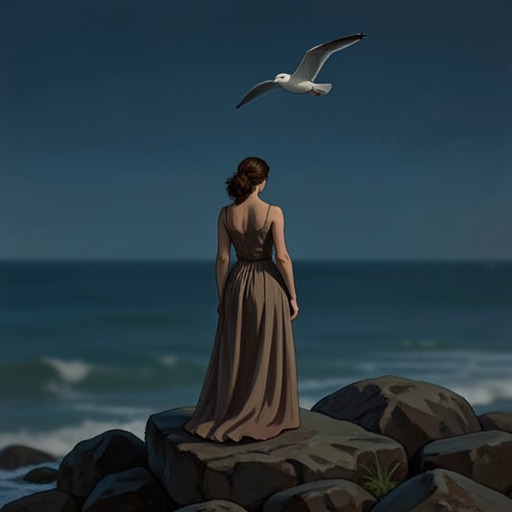
Antigoni Leaves Her Marriage to Christos
Cartes Postales from GreeceAntigoni’s departure from Christos Vandis turns a return to the marital home into a decisive break: the paintings she has made during his absence, and his destruction of them, bring into the open the distance between their lives. When she sees her sister Ismini’s portrait among the works being burned, she leaves the house and takes a ferry the following morning. The episode ends not with reconciliation but with Antigoni’s lasting independence and a career as a celebrated painter.
The House and the Paintings
Christos has been away for more than a year when a cable announces that his boat will return in a week. Antigoni is glad at the prospect of seeing her husband, but wonders how familiar he will feel. His scent has long since faded from his clothes, and she stands beneath the portrait she painted of him, trying to reacquaint herself with the person it represents. The painting has not been part of her attention for many months; its presence in the hallway makes the gap between a remembered image and a changed relationship visible.
During Christos’s absence, Antigoni has made the dining room her studio. She has worked for long hours on four large oil portraits, each more than a metre wide, and called on a local carpenter to make heavy, moulded dark-wood frames. The stiff ancestral portraits have been replaced by her own work. These pictures are not simply decoration: their subjects are people who helped ease her loneliness over the preceding months. By placing their faces where the family portraits once hung, Antigoni has altered the household’s public image as well as its interior.
The paintings give particular form to a circle of relationships formed during Christos’s absence. They include the figure known as the wet witch, a maverick priest, a couple whose resemblance makes them appear even more like father and daughter than they do in life, and a rugged fisherman. The fisherman has spent a quiet hour with Antigoni, during which she made five drawings and gave him one. Her finished portraits extend that attention into sustained work: she has tried to capture the subjects’ particular presence, and the framed images now seem to meet the returning husband’s gaze.
The Return and the Rupture
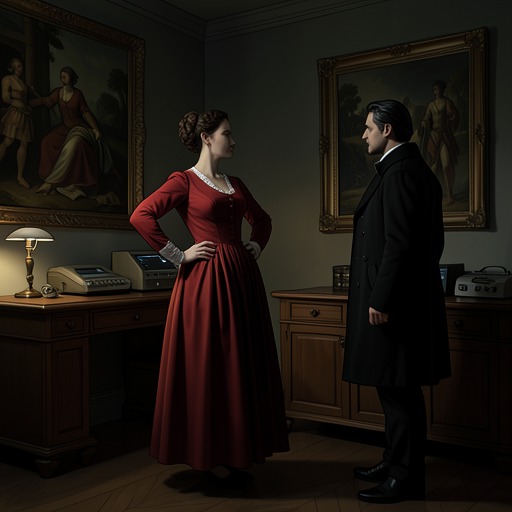
When Christos comes home, the dining room has been restored for a formal dinner, and Antigoni has put away her easels, brushes, and paints. Their greeting is marked by formality. They had scarcely known one another before he left, and now they must become acquainted again. The careful preparation of the room cannot make the reunion intimate; instead, it brings Christos directly into the space Antigoni has reshaped.
He walks around the table and looks at the portraits, but does not recognize what Antigoni has accomplished. His attention turns instead to the absence of the family pictures. He demands that the new works be taken down, then leaves the room in anger. The conflict is not only about which images belong on the walls. Antigoni’s portraits preserve the importance of people and experiences from a life she has made while her husband was away; Christos’s response is to insist that the house return to its former arrangement.
The confrontation continues in the yard, where Antigoni finds the four portraits and her leather portfolio piled on kindling. Christos has set them alight. She sees individual pictures curling away from the portfolio and recognizes Ismini’s portrait among them. That sight makes the destruction personal in a new way: the fire threatens not only Antigoni’s work, but an image of her sister. She pulls away from Christos and runs through the house and out of the front door. The burning portrait is the immediate turning point from shock to departure.
Leaving and Its Aftermath
A ferry is due early the next day, and Antigoni is willing to face whatever consequences follow from leaving. She goes to the schoolmaster, who gives her money for the bus and ferry. His practical help makes the escape possible, while her willingness to accept the consequences marks the decision as hers. She does not wait for Christos to agree with her or for the household to restore her paintings; she leaves the home and the marriage behind.
A few months later, Antigoni sends the schoolmaster a painting in thanks. The gift becomes part of a longer account of the value of her work: a decade later, she is a celebrated painter, and he can sell the still life she gave him and retire. The painting therefore links her first act of departure to the independent life that follows, while also recording the support she received when she needed the means to go.
Christos continues to spend long periods at sea and returns only for short breaks to the dusty family home. Antigoni never returns to Piraeus. The Vandis mansion eventually becomes a guesthouse, a change of use that contrasts with the authority the house once exercised over her life. The narrative presents her departure as an enduring separation, not a temporary protest: the portraits are destroyed, but the painter’s future is not.